How to Check Active Boil-Water Advisories at Your Mississippi Address
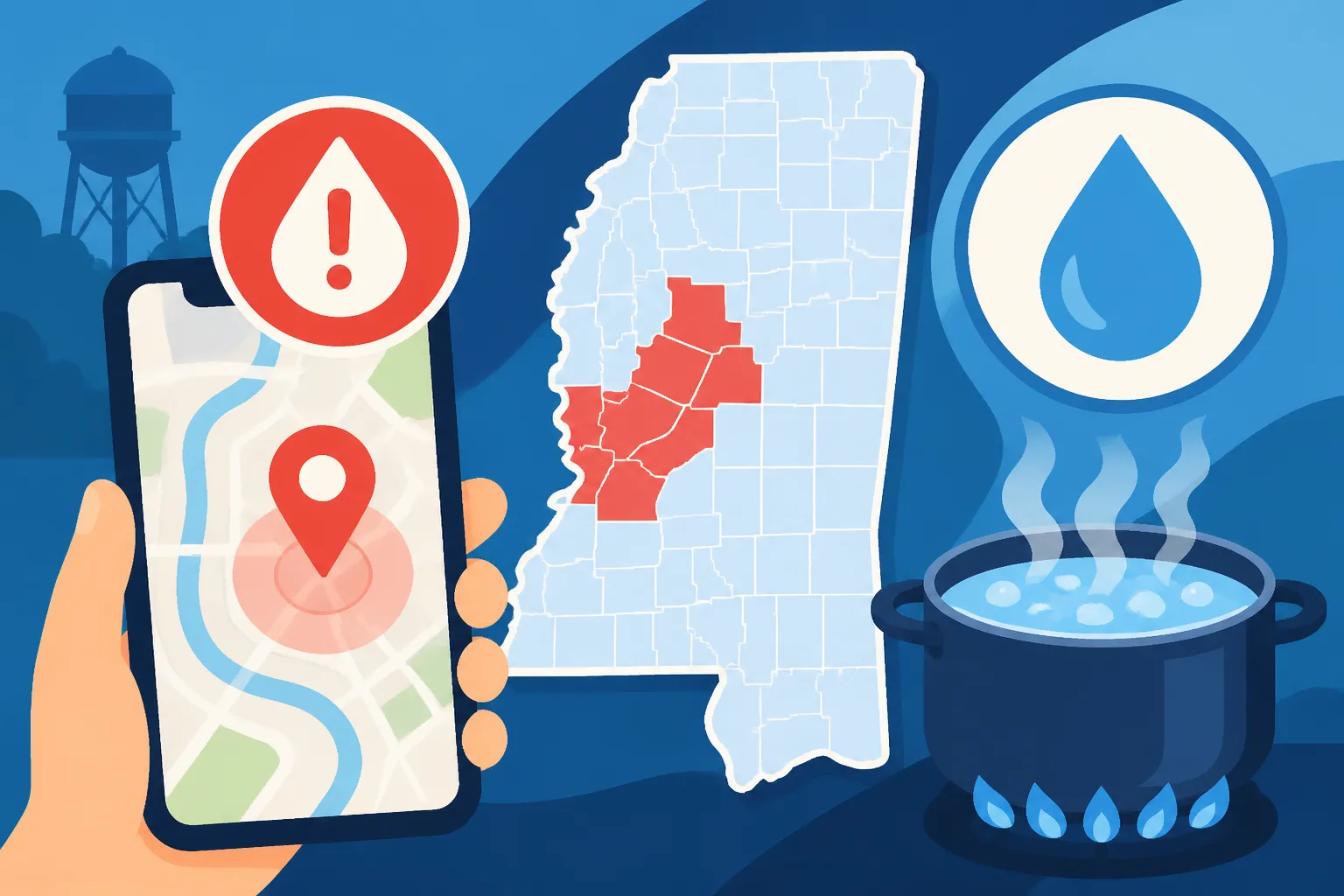
An alert can affect one street, one pressure zone, or an entire water system, so a citywide search may not tell you whether your Mississippi tap is covered. The safest approach is to identify the provider serving your exact address, check its current notices and state resources, then confirm the alert’s boundaries and status with an official source before using tap water.
Start with the water provider serving your address
A boil-water advisory is issued for a defined public water system or part of one—not automatically for every home in a city or county. That makes identifying your water provider the first step. A nearby city name, postal address, or utility logo on an old bill may not be enough: service boundaries can cross municipal lines, and some communities receive water from a regional supplier.
Check a recent water bill, account statement, or service-start document for the provider’s name. If you rent, ask the landlord or property manager which utility serves the building, but verify the answer against a bill or directly with the provider. A neighborhood association or nearby business may be served by a different system.
If you do not know the provider, use Who Supplies Your Tap Water? How to Identify Your Mississippi Utility for ways to narrow it down. You can also contact the utility that appears most likely and ask it to confirm service at your full address. Use its official website to find current contact details.
Check the entire service address
When you search a utility’s website or contact its staff, give the full street address, including the city, ZIP code, apartment or unit number, and any building or lot identifier. For a multi-unit property, ask whether the alert covers the entire building or only a particular service connection. A street name alone may not identify the right pressure zone or account.
If the property has a private well, rather than a connection to a public water system, a city utility advisory generally does not establish the safety of that well. Well owners need information specific to their source and should contact the local health department about a suspected well-water problem. For background on the difference between public supplies and private sources, see Mississippi Public Water Systems: Groundwater vs Surface Water.
Do not assume the nearest city is your provider
A rural address may receive water from a water association or another public system. Some cities also purchase water from a regional supplier, while the city remains the customer-facing utility. In either case, the alert you need is the one that applies to the system delivering water to your address.
If a notice names a system, compare that name with the provider on your bill. If the names differ, ask the local utility which system supplies your tap and whether the notice applies to your service area. Tracking Purchased Drinking Water in Mississippi Systems explains why the supplier named in a notice may not be the same name a customer sees on a bill.
Check official sources in a useful order
There may not be one page that shows every active advisory in Mississippi, and a state listing may not update at the same moment as a utility’s emergency notice. Use more than one official source when the status or boundaries are unclear.
| Source to check | What it can help confirm | What to verify |
|---|---|---|
| Your water provider’s official website | Current notices, affected areas, instructions, and updates | Whether your exact address or service area is included and whether the notice is still active |
| Provider alerts or customer service | Address-specific guidance and recent status changes | The notice’s start time, boundaries, and official lifting notice |
| Mississippi State Department of Health drinking-water resources | State-level information about public water systems and advisories | Whether the information is current and whether the system name matches your provider |
| Local news or community posts | Clues that an advisory may have been issued | Confirm the claim with the provider or an official state source before acting on it |
| A printed door hanger or posted notice | Instructions delivered to affected customers | Whether a newer update has changed the advisory’s status |
Check the provider first
Look for a section labeled “alerts,” “notices,” “service updates,” or “boil-water advisory.” Search the provider’s official website for the system name, street or neighborhood named in a notice, or the phrase “boil-water.” A provider may post an alert on its home page, a dedicated notifications page, or a customer account portal. Not every utility uses the same format.
Read the full notice, not just the headline. Look for the issue date and time, the affected streets or service areas, the reason for the advisory if provided, the instructions, and the latest update. A search result or old social media post may remain visible after a notice has been lifted—or may refer to an earlier advisory with similar boundaries.
If the website is difficult to search, use the contact method listed on the provider’s official website. Ask directly: “Is there an active boil-water advisory for my full service address?” Then ask what area is affected and whether the provider has issued an official end notice. For more on finding and checking a supplier’s report and contact route, see Contacting Your Mississippi Water Provider for Past Test Results.
Use state resources as a cross-check
The Mississippi State Department of Health (MSDH) oversees public drinking-water matters in coordination with water systems. Its public water supply information can help you identify or check a system, but a general state resource may not show every immediate, address-specific update. The water provider is often the best source for the precise boundary and the most recent instructions.
If the state information and a provider notice appear to conflict, do not treat the older or less specific item as proof that the advisory has ended. Ask the provider to clarify, and check for a newer official notice. How MDEQ and MSDH Regulate Mississippi Public Drinking Water Quality provides more context on the agencies’ roles.
Confirm the advisory’s boundaries and status
Finding a notice is only part of the check. You also need to establish whether it covers your connection and whether it remains active. Notices may identify affected streets, neighborhoods, pressure zones, or portions of a system. A notice that names a nearby road does not necessarily include every property on that road.
Match your address to the notice
Compare the address on your water bill with the notice’s description. Check street names, road limits, landmarks, subdivision names, and any listed service area. Pay close attention to wording such as “from one intersection to another,” “customers on the east side,” or “the following pressure zone.” If the notice gives a map, check the map legend and boundaries rather than relying on a pin or shaded area without context.
If the notice lists only a broad neighborhood or system name, contact the provider and ask whether your specific account or address is included. This is especially important for properties near an edge of the affected area, buildings with shared plumbing, and addresses where the city or utility boundary is not obvious.
Check the date and whether there is a lift notice
An advisory remains in effect until the responsible provider or agency issues an official notice that it has been lifted or provides different instructions. A repair being completed, water pressure returning, or a neighbor saying the water looks normal is not the same as an official end notice.
Look for wording such as “advisory lifted,” “boil-water notice rescinded,” or a clear statement that customers may resume normal use. Check the date and time of that update, since an older notice may still appear on a page after a newer one is posted. If you cannot find a lift notice, ask the provider directly whether the advisory is still active.
Do not assume that an advisory has ended because the water is clear, has no unusual taste, or seems to be flowing normally. Those observations do not confirm the status of a public health notice. For more on how notices are issued and communicated, see How Mississippi Water Systems Send Out Boil-Water Alerts.
Understand the type of notice
A boil-water advisory typically tells customers to boil water for specified uses because the system’s water may not meet the provider’s microbiological safety requirements. A “do not drink” or “do not use” notice can involve different risks and may require different steps. Do not substitute boiling for other instructions unless the notice specifically says to do so.
Read the precise wording. If a notice is unclear, ask the provider what water uses are restricted and what alternatives to use. Understanding Boil-Water Notices Across Mississippi Cities explains how notices can vary by situation, while Handling Boil Notices for Dishwashing, Cooking, and Formula covers common household tasks under a boil-water notice.
What to do while an advisory is active
Follow the instructions in the current notice for every use it covers. Do not rely on a general rule from another city or an older advisory: instructions can vary depending on the event and the provider’s response.
If the notice says to boil water, use bottled water or prepare tap water according to the notice before drinking, cooking, brushing teeth, or preparing food or beverages. Follow its exact directions for boiling and storage. If you cannot boil water safely or reliably, use an appropriate alternative specified by the provider or local health department. Do not assume that a refrigerator filter, pitcher, or faucet filter makes water suitable during an advisory.
Some notices specify different precautions for handwashing, bathing, dishwashing, ice, or appliances. Follow the notice for each use rather than extending one instruction to every situation. If the notice says not to use the water, follow that instruction even if boiling is possible. People who need individualized health guidance should ask a medical professional or local health department.
Check the scope of the instructions
A notice may cover drinking and food preparation but give separate directions for other uses. It may also provide instructions for:
- Ice and ice makers
- Baby formula and beverages
- Brushing teeth
- Handwashing and bathing
- Dishwashing and kitchen equipment
- Pets or other household uses
- Water stored before the advisory
Use the provider’s directions for each item. If an item is not addressed, contact the provider or local health department for clarification instead of guessing. Additional practical details are available in Showering and Handwashing Under a Boil-Water Notice: Practical Rules and How to Safely Run Your Ice Maker After a City Boil Advisory Ends.
Take extra care with stored water and appliances
If you have stored tap water, do not assume it is appropriate to use just because it was collected before you noticed the alert. Check when it was collected and what the notice says about water stored before the advisory. Ice made from tap water may also be covered by the notice; follow the utility’s instructions for discarding or replacing it and cleaning affected equipment.
If your home uses a point-of-use filter, do not treat it as a substitute for the notice’s directions. Filters vary in design and performance, and many are not intended to address every concern that may prompt an advisory. A filter’s certification and stated reduction claims should be checked against the specific contaminant and situation. For general filter-selection guidance, see Guide to Choosing Home Water Filters Across Mississippi.
If you cannot find an advisory for your address
A missing notice on a website does not prove that no advisory applies. The provider may use a different page, have sent a direct notification, or be updating its channels. It is also possible that you are searching under the wrong utility or system name.
Use this sequence to get a reliable answer:
- Confirm your provider. Check a recent bill or service document, or ask the property owner or manager. If the provider is unclear, use How to Check Your Mississippi Water Quality Report and PFAS Data only for report-related context; a water quality report is not a substitute for a current advisory check.
- Search the provider’s official channels. Check its alert page, home page, customer portal, and any official social account linked from its website. Look for the date and service-area details.
- Ask about your full address. Use the provider’s current contact details from its official website. Ask whether an active notice covers your service connection, not merely whether the city has an advisory.
- Check MSDH information. Search by the public water system name where possible. If you still cannot tell whether your address is included, ask the provider or MSDH for clarification.
- Follow any notice delivered to your property. Keep a door hanger or mailed notice and read its exact instructions. If it appears out of date or conflicts with a newer source, confirm the current status with the provider.
- Use cautious steps while you verify. If you have a specific reason to believe your area may be under an active advisory, use bottled water or follow the most recent official instructions you have until the provider confirms the status.
A water quality report describes monitoring results over a reporting period; it does not tell you whether a boil-water advisory is active at this moment. For help locating the right report, see How to Read a Mississippi Consumer Confidence Report for Your City. For an active notice, prioritize current provider instructions.
When official information is inconsistent
If a provider page says an advisory is active while a social post says it has ended, follow the current official notice and ask the provider to confirm. If a notice on a door says one thing but an online update says another, check the date and time on both, then contact the provider. Do not rely on a neighbor’s recollection or a repost without a link to the original notice.
If the provider is temporarily difficult to reach, check its website again for updates and consult MSDH information. Keep using the last applicable official instructions until a responsible authority confirms a change. If the notice concerns a health risk and you need personal advice, contact the local health department or a medical professional.
Why advisories are issued and how they end
A boil-water advisory can follow a water main break, loss of pressure, a treatment or distribution problem, or a water-quality sample that requires investigation. The notice is a precaution or response tied to a specific event; its presence does not necessarily mean every tap in the community is affected. Likewise, a repair being completed does not by itself establish that the system has met the conditions for lifting the notice.
Water providers determine the affected area based on system operations and the event. They may isolate part of a network, identify a pressure zone, or issue instructions to a broader group while they investigate. That is why two nearby homes can receive different guidance, particularly when they are connected to different systems or distribution zones.
Ending an advisory may involve repairs, flushing, disinfection, sampling, or other checks as appropriate to the circumstances. The provider or responsible agency communicates when customers can resume normal use. Customers should not decide independently that the water is ready based on appearance, pressure, or time elapsed.
For information on what can lead to an advisory after a sample, see When Boil Water Advisories Follow Total Coliform Detections. If you want to understand routine testing and reporting rather than an active alert, How Often Mississippi Public Systems Collect Water Samples and Reading a Mississippi Water Quality Report: Where Your Supply Begins cover those topics.
Keep a simple record of what you checked
When an advisory is active or uncertain, note the provider name, the date and time you checked, the affected area described, and where the update appeared. Save the provider’s notice or take a screenshot for household reference. This helps avoid relying on an old message when a new update arrives.
For landlords, property managers, and households with several occupants, share the official notice and its latest status with everyone who uses the water. A printed copy can be useful if a resident does not receive digital alerts. Before the notice is lifted, make sure the household knows which instructions remain in effect.
Sign up for future alerts
Ask the provider whether it offers opt-in text, email, phone, or account alerts, and whether notifications are available for the service address. Keep contact details current and check whether the provider sends alerts to the account holder only. Renters may need to ask the property manager to share utility notices promptly.
Notification systems can supplement—but should not replace—checking an official notice when you hear about a possible problem. A phone number may be outdated, a message may not reach every resident, and an alert can be posted before a subscription message arrives. Knowing the provider and its official alert page in advance makes a fast check easier.
Frequently Asked Questions
Does a boil-water advisory apply to every home in a Mississippi city?
Not necessarily. An advisory may cover a whole water system or only a defined part of it. Check the provider’s notice for boundaries and confirm your full service address if the area is unclear.
Is a boil-water advisory the same as a “do not drink” notice?
No. The instructions can differ. Follow the exact notice issued for your area, and do not assume boiling is appropriate when a notice says not to drink or use the water.
Can I rely on a neighbor’s message or a social media post?
Use those messages as a reason to check, not as final confirmation. Verify the active status, boundaries, and instructions with your water provider or an official state source.
Does a clear-looking tap mean the advisory is over?
No. Appearance and pressure do not confirm that an advisory has been lifted. Wait for an official end notice or ask the provider to confirm the status.
Disclaimer
This article is for general informational purposes only and does not constitute professional advice. Laws, prices and regulations vary by location and change over time. Consult a qualified professional for guidance on your specific situation. Mississippi Water Guide is not a government agency or water utility and is not affiliated with any public water system.